
Learn what a waste treatment skid is, how water moves through its stages, when a skid beats a site-built plant, and how to size one from your flow and contaminant data.
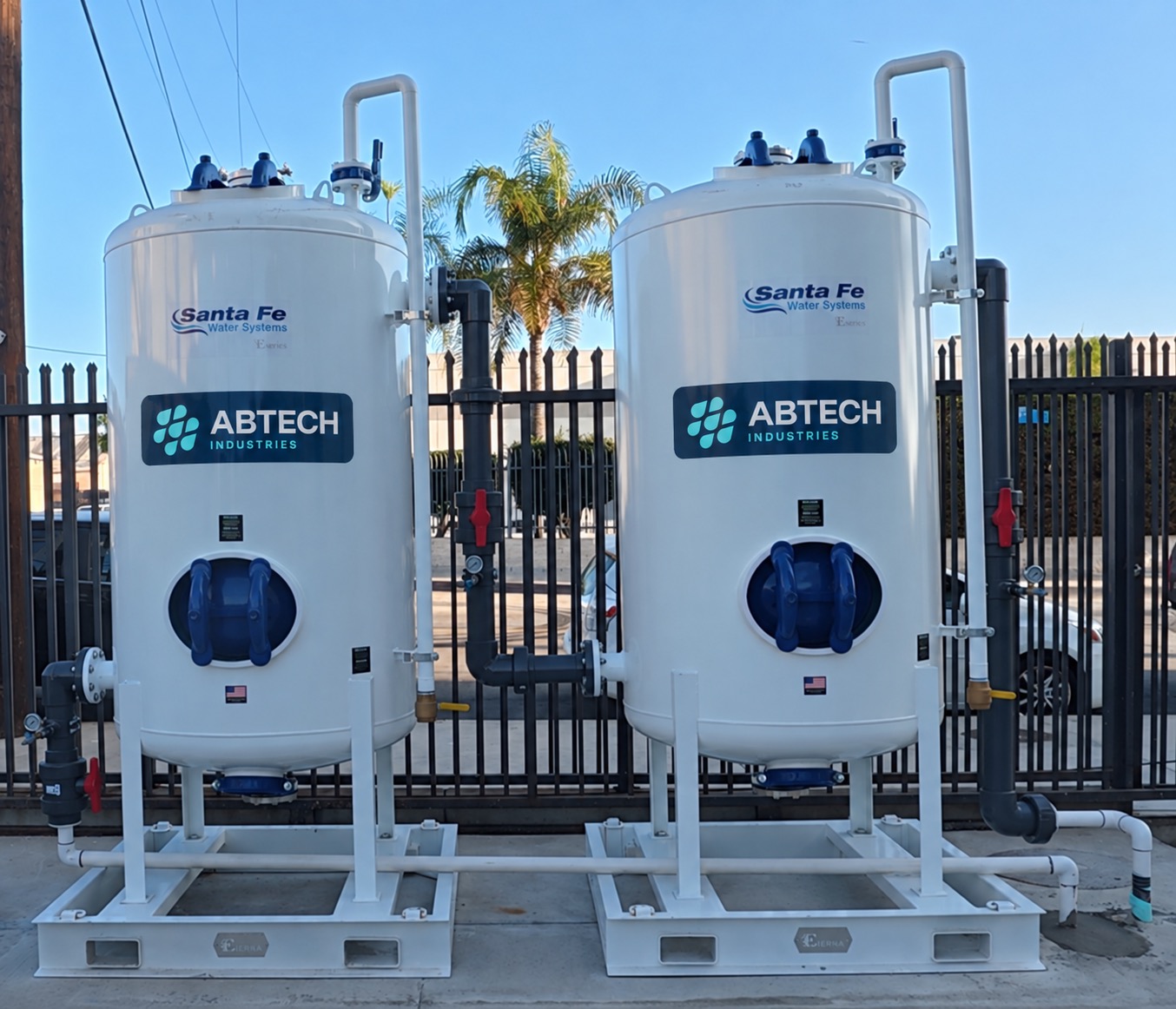
A waste treatment skid is a treatment train built in a factory on one structural steel frame. It carries pumps, tanks, separators, filter or adsorption vessels and controls, and it arrives pre-piped and pre-wired. A skid makes sense when you need treatment in months rather than years, at flows a truckable frame can carry. Size it from your flow, solids loading and contaminant data, and test the media on your own water.
What is a wastewater treatment skid?
It is a complete or partial treatment train welded onto a steel frame and shipped ready to set in place. The frame typically supports tanks, mixers, pumps, filtration or adsorption vessels and a control cabinet. One industrial pretreatment unit, for example, puts chemical feed, a treatment tank, a rotary vacuum drum filter and automation on a single skid. Oily-water skids group the separation equipment with the motor pumps and valves in one package.
Our own version is the Smart Skid, a skid-mounted system with pumps, pressure and flow controls for packaged treatment. We also supply bulk Smart Sponge® media for loading into skids, pressure vessels, tanks and vaults you already own. More on how media and equipment fit together is on the Water Treatment & Compliance Blog.
How does water move through a treatment skid?
Pumps push water through stages in series, and each stage targets one fraction of the contaminant load. Free oil and settleable solids come out first, dispersed oil and fines next, and adsorption media takes the dissolved fraction the earlier stages leave behind.
A wash-water recycling skid shows the pattern. Its three stages run in order: a gravity separator pulls out most of the free oil and the solids that settle, a coalescing step handles finely dispersed oil, and activated carbon finishes off leftover hydrocarbons and odour. Larger plants add dissolved or induced gas flotation, biological reactors, multimedia or ultrafiltration skids, and sludge dewatering.
Name the fraction first, then choose the stage that targets it:
- Free oil: separator.
- Dispersed oil: coalescing media or hydrophobic Smart Sponge® media.
- Dissolved metals and phosphorus: Smart Sponge® HM.
- Dissolved organics that raise TOC: Smart Sponge® AC.
- PFAS: Smart Sponge® Quanta™.
When the water carries more than one class, combine media in one system. We can also place Smart Sponge® downstream of a DAF unit to polish specific contaminants before discharge or reuse.
Oil and hydrocarbons absorb into Smart Sponge® and are retained, while metals and other contaminants are held at the media surface. Sediment and TSS controls miss the dissolved fraction, so check your lab report for it. The dissolved versus total metals guide shows how to read it.
When is a skid better than a built-in treatment plant?
A skid wins when schedule, relocation or limited site work matter and flow stays within what a frame can carry. A site-built plant wins at very large capacities. Passive vault or insert formats win on stormwater where you have no power or pumping.
| Factor | Treatment skid | Site-built plant |
|---|---|---|
| Typical lead time | 3-6 months | 18-24 months |
| Site work | Minimal civil work beyond foundations and utility connections | Civil construction |
| Capacity | Transport limits start to bite above 5,000 m³/day | Suits very large capacity |
The capacity figures from different makers look inconsistent, but they describe different things. One skid-mounted biological package covers 30-200 m³/d (8,000-60,000 gpd). A single train of the same package plant reaches 230,000 gpd (870 m³/day), and more trains can be added. Modular plants in general run from 5 to 5,000 m³/day. A federal cost model assumes package plants for pressure carbon systems under 1 million gallons per day. Above roughly 5,000 m³/day, transport limits end single-skid sizing. A 2,000 m³/h plant is 48,000 m³/day, and at that size it is civil basins plus modular skids.
Passive formats need no power. The Ultra Urban® Filter retrofits existing basins without excavation or pumps. For high-volume stormwater sites we build full-flow treatment into new or existing vaults, and in high-intensity storms flow beyond the unit's treatment capacity is routed over the filter through an internal bypass. If your problem is stormwater rather than process water, read the catch basin retrofit decision guide before pricing a pumped skid.
What drives the cost of buying and running a skid?
Capital cost follows the number of stages and the equipment size, and size is set by solids loading, daily volume and operating hours. A larger vacuum-filter pretreatment line, for instance, is chosen on those three inputs. Fixed-price procurement is common for skids because there is little site construction exposure. A skid price generally depends on flow and contaminant data.
Running cost has three parts:
- Pump power.
- Operator time. One wash-water skid vendor describes a visual differential-pressure check daily, a weekly oil chamber inspection and a quarterly carbon element replacement.
- Media change-out and disposal.
On disposal, spent Smart Sponge® passes the EPA leach test (TCLP) and goes to a landfill, waste-to-energy plant or cement kiln as ordinary solid waste. Reuse can offset running cost. The same wash-water vendor quotes payback typically under 24 months at local water and sewer tariffs, though that figure applies to car and truck wash sites.
How do you size and specify a treatment skid?
Start with design flow, operating hours, solids loading, and the pollutants and fractions named in your permit and recent sampling. Then confirm media choice and change-out frequency with column testing and a pilot on your own water before you buy full scale.
Before you choose, check these:
- Peak versus average flow, since turndown matters.
- Free, dispersed and dissolved fractions, not just totals.
- Where the skid ties in, and whether existing vessels, tanks or vaults can hold media instead.
- Access for media change-out and spent-media handling.
- Whether one location or several points in the drainage network gives the better result.
We can evaluate retrofits as well as treatment in a new design, and our solutions integrate into existing systems whether you need a complete platform or just media for equipment in place. Visit Abtech Industries to get started.