
Learn how to identify NAL exceedances in stormwater samples and the mandatory Exceedance Response Action steps required by permits, including timelines and reporting.
An NAL exceedance occurs when your stormwater samples exceed the Numeric Action Levels defined in your permit. This triggers a mandatory Exceedance Response Action (ERA) process. It is not an automatic permit violation, but it requires corrective controls and specific reporting.
What is an NAL exceedance?
An NAL exceedance occurs when your stormwater samples exceed the Numeric Action Levels defined in your permit, which are derived from TMDLs or benchmarks. These levels function as water quality-based effluent limitations for industrial stormwater discharges. Under the California Industrial General Permit, there are two distinct types of NAL exceedances: annual and instantaneous maximum. An annual NAL exceedance happens when the average of all sampling results within a reporting year for a single parameter exceeds the applicable annual NAL. An instantaneous maximum NAL exceedance occurs when two or more analytical results from samples taken for any parameter within a reporting year exceed the applicable instantaneous maximum NAL value. Instantaneous maximum NALs are only established for pH, Total Suspended Solids, and Oil and Grease.
How is an NAL exceedance determined?
It is determined by comparing your annual average results or individual instantaneous samples against the specific NAL values for each parameter. NALs do not take effect until one year after the effective date of your permit. For annual NALs, you calculate the average of all sampling results for a single parameter within a reporting year, excluding pH. If this average exceeds the applicable annual NAL, you have an annual exceedance. For instantaneous maximum NALs, the determination is based on individual sample results rather than an average. You have an instantaneous exceedance if two or more analytical results for a parameter exceed the applicable instantaneous maximum NAL value within a reporting year. This distinction matters because instantaneous NALs target hot spots or episodic discharges, while annual NALs reflect overall loading over time.

Is an NAL exceedance a permit violation?
No, an NAL exceedance is not an automatic violation, but it is a trigger for the Exceedance Response Action (ERA) process. Under the Multi-Sector General Permit, an exceedance of an applicable benchmark does not itself constitute permit noncompliance. However, any noncompliance with the requirements of the permit constitutes a violation of the Clean Water Act. If you fail to implement the required corrective actions or submit the necessary reports after an exceedance, that failure becomes a violation. The exceedance itself signals that your discharge may be contributing to an exceedance of applicable water quality standards. If the average of the 4 quarters of monitoring values exceeds the benchmark, you are required to perform corrective actions and conduct an additional 4 quarters of monitoring. Reporting the exceedance to the regulator is also mandatory.
What must you do after an NAL exceedance?
You must enter Level 1 ERA status, review your SWPPP, and implement operational source control BMPs within a specific timeline. When an exceedance is found, Level 1 status begins on the following July 1. You are required to review your Stormwater Pollution Prevention Plan and implement operational source control Best Management Practices. These actions address the immediate sources of pollution contributing to the exceedance. The permit requires you to submit a Level 1 ERA Report to the regulator. This report documents your evaluation and the corrective actions you have taken. You must also update your SWPPP to reflect any significant revisions, including new BMPs added under Level 1. These updates must be certified in the regulator's reporting system.
What are the ERA levels?
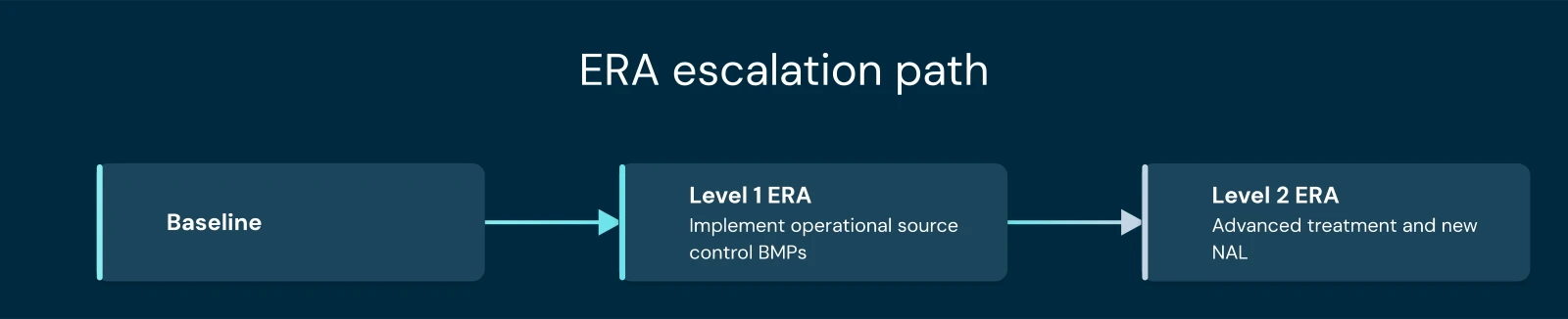
The process is two-tiered: Level 1 focuses on operational source controls, while Level 2 requires advanced treatment and a new NAL. All facilities start at the baseline level. If you exceed a NAL, you move to Level 1, where you implement operational source control BMPs and submit a Level 1 ERA Report. Level 2 is triggered by a second exceedance of the same parameter. At this stage, you must certify one of two conditions: either you are using Best Available Technology/Best Control Technology and no more BMPs are available, or the exceedances are not from industrial activity but from background sources. You then submit a Level 2 ERA Report and provide a new NAL. Reports required in Level 2 status must also be prepared by a Qualified Industrial Stormwater Practitioner.
What is the timeline for corrective action?
Level 1 status begins on July 1, BMPs must be implemented by August 30, and the Level 1 ERA Report is due by January 1. You must submit sampling results to the regulator within 30 days of receiving lab results. Significant SWPPP revisions, including any BMPs added under Level 1 or 2, must be certified in the reporting system within 30 days. The Level 1 ERA Report is prepared by a Qualified Industrial Stormwater Practitioner from the Level 1 ERA Evaluation. This report is then submitted and certified in the regulator's system. These dates are fixed by the permit and do not shift based on when you receive your lab results. Missing the August 30 implementation deadline or the January 1 report deadline constitutes noncompliance with the permit requirements.
What reporting is required?
You must submit a Level 1 ERA Report prepared by a QISP and update your SWPPP in the regulator's system (e.g., SMARTS). The Level 1 ERA Report documents your evaluation of the exceedance and the corrective actions implemented. It must be prepared by a Qualified Industrial Stormwater Practitioner and certified in the reporting system. If you move to Level 2, the Level 2 ERA Report must also be prepared by a QISP. You must submit sampling results within 30 days of receiving lab results. Any significant revisions to your SWPPP, including new BMPs added under Level 1 or 2, must be certified in the system within 30 days. The permit also requires an Annual Report and a Numeric Effluent Limitations Exceedance Report. These reports ensure the regulator has a complete record of your compliance status and corrective actions.
Why do sediment controls fail to resolve NAL exceedances?
Sediment controls capture particulate pollutants but often leave the dissolved fraction of metals and phosphorus in the water column. Before you add treatment, check whether the NAL parameter you exceeded was reported as a total or dissolved value. If it was total zinc or copper, arrange with your lab to collect and filter a separate sample for dissolved metals at the next sampling event so you know what you are treating. If the pollutant is particulate, such as TSS or metals bound to sediment, go back to housekeeping, sweeping and sediment control. If the pollutant is dissolved, sediment-focused BMPs like sump inserts or screens will not resolve the exceedance. You need media that targets the dissolved fraction. A facility that installs only a sediment-focused BMP will capture the particulate fraction but leave dissolved phosphorus untreated, and the next benchmark sample can still exceed.
How do you choose the right treatment for a NAL exceedance?
You must identify the specific pollutant and its fraction (dissolved vs. particulate) to select a media that targets that specific contaminant. The contaminant decides the media, and the site decides the format. If your exceedance involves dissolved metals like zinc or copper, you need media that binds those specific ions. For dissolved phosphorus, you need media that targets orthophosphate. For hydrocarbons, you need media that absorbs and retains oil and grease. For bacteria, you need antimicrobial media. For PFAS, you need media engineered to capture per- and polyfluoroalkyl compounds. The format depends on your site's infrastructure. You can retrofit existing catch basins, vaults, or pressure vessels with filtration media. Passive formats run without power, while pumped systems use pumps for higher flow rates. Results depend on your site's water, so testing on your own water is essential before full-scale deployment.
If you need help matching media and format to your specific NAL exceedance, schedule a site assessment.