
A step-by-step way to test metals removal on your own stormwater: split total and dissolved metals, run a column test, then pilot across real storms. It also shows how to read media life in bed volumes.
Before you buy a metals filter, split your lab results into total and dissolved metals by outfall, run a bench-scale column test on a sample of your own stormwater, then pilot the chosen media in the drainage path. Judge the results by the effluent trend against your benchmark and by how many bed volumes the media treats before it clogs or breaks through. A single removal percentage from one sample tells you very little.
What testing lets you judge
Testing tells you whether a filter's removal holds on your water, at your flows, for long enough to justify the media cost. It also shows whether the metal you exceed on is dissolved, which sediment controls miss.
The options a test might screen differ mainly in how they handle trace dissolved metals and what they leave behind.
| Option | What it does | Limit | Residual |
|---|---|---|---|
| Hydroxide or sulfide precipitation | Lowers solubility so metal forms a solid | Weak at trace concentrations; sensitive to pH | Sludge |
| Coagulation/flocculation | Gathers fine solids so they settle | Cannot reach 100% removal | Sludge |
| Ion exchange | Removes metal ions at low concentrations | Suited to a polishing role, not bulk loads | Spent resin or regenerant |
| Adsorption media | Removes trace metal ions | Depends on water chemistry | Spent media |
| Membranes | Separate metal from water | Fouling | Concentrate stream |
Smart Sponge® HM is our polymeric-based media for dissolved metals (lead, zinc, copper, arsenic and selenium) along with phosphorus. It belongs in the adsorption row, so its result depends on your water chemistry, which is exactly what the test is for.
Step 1: Confirm the exceedance and its trigger
Treat each exceedance as specific to an outfall. Under MSGP corrective action, an exceedance requires a review of your SWPPP and of the control measures tied to that outfall.
Check the benchmark in your own permit for each metal. As one example, Washington's ISGP sets copper at 14 µg/L and zinc at 117 µg/L; that is a state permit, so use your permit's values for the test targets.
Step 2: Find the source and the dissolved fraction
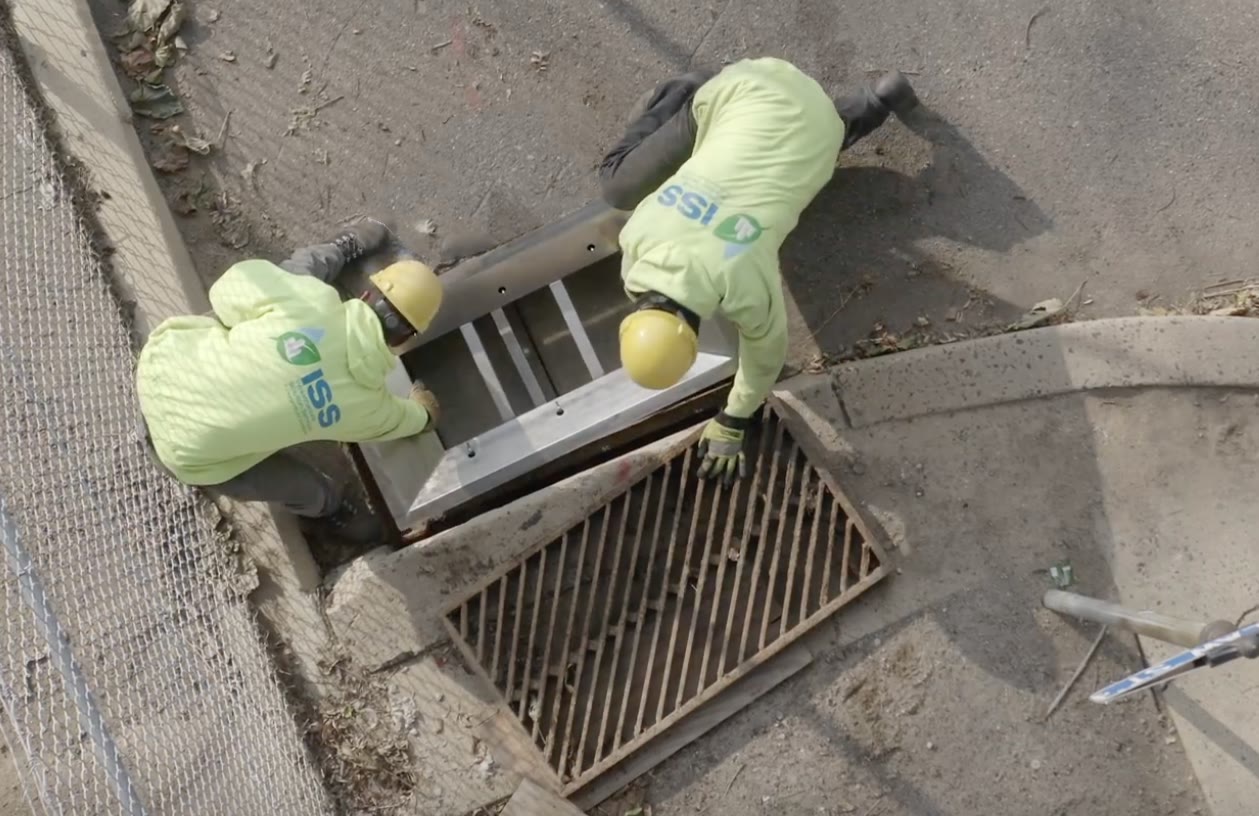
Map each outfall to the storage, cutting, galvanized and traffic areas that drain to it, and estimate the load from each sub-basin. One industrial zinc study divided a site into building roof, metal roof and paved areas, then measured or calculated concentration and mass load for each. Then compare total and dissolved results on the same lab report.
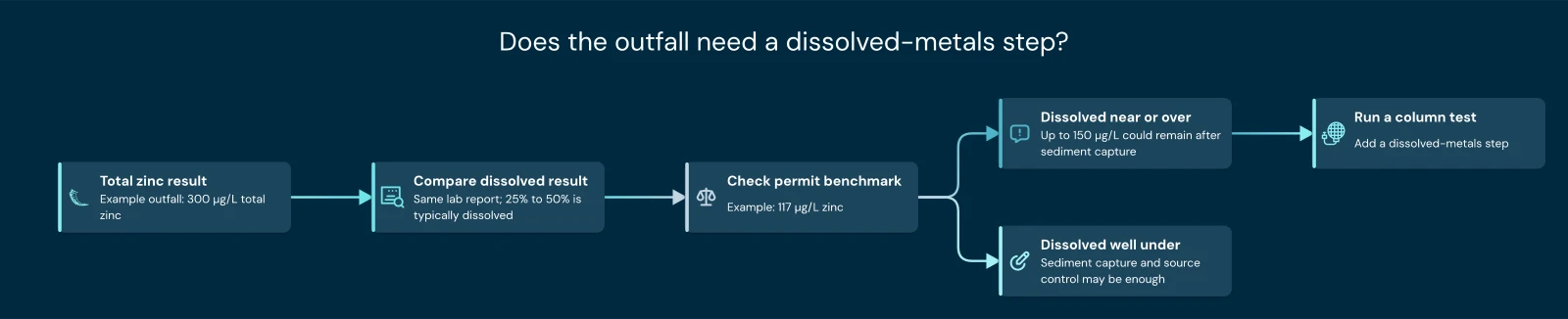
Here is the decision rule. Say one outfall shows total zinc of 300 µg/L. Zinc is readily soluble, and typically 25% to 50% of the load is dissolved. That gives 300 × 0.25 = 75 µg/L up to 300 × 0.50 = 150 µg/L dissolved. Against a 117 µg/L benchmark, a sediment control that caught every particle could still leave up to 150 µg/L, so you need a dissolved-metals step and a column test. If your own dissolved result sits well under the benchmark, sediment capture and source control may be enough.
Our site assessment covers the same ground: contaminants, flows, available space, effluent targets and maintenance access.
Step 3: Run a column test on your water
Draw a representative sample at the point where treatment will sit, then run it through columns of each candidate media at the contact time the full-scale unit would give. One published bench test used a 15-gallon sample taken from an oil-water separator outlet and screened pressurized filtration, adsorptive media and ion exchange before choosing a train.
Test the mixed stream, since adsorption behavior changes as metal mixtures get more complex. Record pH, conductivity and major ions beside the metals, and record turbidity and particle size, because clogging is a separate failure from metal breakthrough. We do the testing, engineering and manufacturing ourselves in Phoenix, so the same team that runs your column test is there for what follows. A candidate moves to pilot when its effluent stays under your target across the volume you tested and the pretreatment need is clear.
Step 4: Pilot across real storms
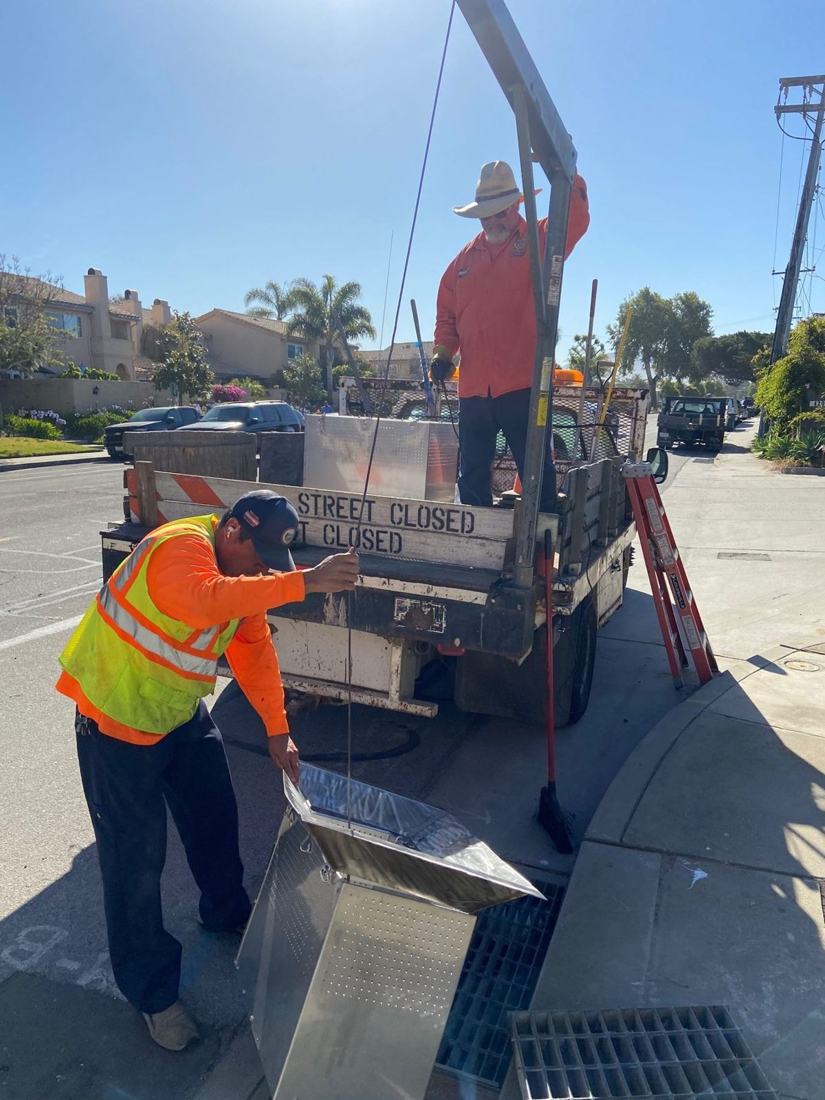
A pilot puts the media in the actual drainage path, where it sees real flows, sediment and first flush. Sample influent and effluent at each event and log the volume treated.
The roof-runoff study ran a roughly month-long pilot comparing two media combinations in a fabricated downspout unit. Plan for several storms rather than one.
Once you have pilot results to compare against a full-scale design, that is the point to talk to us about a site assessment and pilot.
Reading cost and media life from test data
Cost follows the flow you must treat, the format that fits your existing infrastructure, the pretreatment needed to prevent clogging, and how fast metal loading uses up the media. Passive formats such as the Ultra Urban® Filter run without power, while Smart Skid systems use pumps. If you already have vessels, skids, tanks or vaults, bulk media can load into them.
Express pilot life in bed volumes: total volume treated divided by media volume. In the roof-runoff study, peat treatment appeared to decline after around 3,000 bed volumes. With 10 gallons of media, 10 × 3,000 = 30,000 gallons treated, for that media and that water only. Repeat the sum with your own media volume, measured runoff and effluent trend.
Lifespan depends on metal loading and water chemistry, so there is no universal interval. Track influent, sample effluent on a schedule, and change media as effluent trends toward your limit. We plan changeouts and check media condition as your site changes. Compare quotes on cost per bed volume treated, not purchase price.
The step most often skipped
The usual cause of continued exceedances is choosing a system before splitting total from dissolved metals and before testing the mixed stream with realistic sediment. The result is more sediment capacity aimed at a dissolved problem, or a media bed that clogs early. Sampling practice can also create a false exceedance pattern, so confirm that samples are taken consistently across storms and at the correct point in the discharge before you design around the data.
Ask any vendor for the sample volume, contact time, number of storms and effluent trend behind their test. Final compliance depends on your whole stormwater program: design, operation, monitoring and permit requirements. Visit Abtech Industries to get started.